BEFORE THE TAN SON NHAT UAV INTRUSION: A COMPANY HAD PREVIOUSLY PROPOSED DEVELOPING A CHIP TO CONTROL ALL UAVS NATIONWIDE
A Vietnamese company previously proposed encoding the entire body of UAV regulations into a processor chip and using it as a nationwide UAV regulatory-compliance and certification chip.
UAV Intrusion at Tan Son Nhat Raises Aviation Security Concerns
On the evening of August 11, Tan Son Nhat International Airport in Ho Chi Minh City was forced to suspend takeoff and landing operations twice after unmanned aerial vehicles (UAVs) were detected entering restricted airspace.
Specifically, at 5:34 p.m., the control tower received a report from the flight crew of Vietjet flight VJ601, operating from Cam Ranh to Ho Chi Minh City, that a UAV had been spotted while the aircraft was preparing to land. The object was approximately 10 miles (more than 16 km) from the airport at an altitude of 3,000 feet, or over 900 meters. The tower subsequently received another report of a UAV operating at approximately 1,800 feet (nearly 550 meters).
To ensure aviation safety, the airport activated its emergency response procedures and temporarily suspended all takeoff and landing operations. Flight operations resumed at 7:16 p.m.
However, at approximately 7:34 p.m., the control tower again received a report of a UAV appearing west-southwest of the airport, possibly over areas formerly under Binh Chanh, Hoc Mon, or Cu Chi. Tan Son Nhat was once again required to suspend all arriving and departing flights.

According to the Vietnam Air Traffic Management Corporation (VATM), this was the first recorded instance of a UAV entering the restricted airspace surrounding Tan Son Nhat International Airport.
Preliminary figures from airlines showed that during the two periods in which takeoff and landing operations at Tan Son Nhat were suspended on the evening of August 11, approximately 64 Vietnam Airlines flights were affected, impacting more than 10,000 passengers on domestic services.
Of these, 15 flights from other airports to Ho Chi Minh City and another 15 flights in the opposite direction had their schedules temporarily suspended. Approximately 14 flights were required to enter holding patterns or divert to alternative airports while the incident was being handled. The disruption subsequently had a knock-on effect on approximately 20 additional flights from the night of August 11 through the morning of August 12.
In addition to Vietnam Airlines, Vietjet, Sun Phu Quoc, and several other carriers had approximately 26 flights affected, involving thousands of passengers.
The Tan Son Nhat Approach Control Center also recorded a total of 73 flights directly affected during the more than two-hour UAV incident at Tan Son Nhat, excluding subsequent knock-on disruptions.
Relevant authorities are continuing to investigate the origin of the UAVs that entered the area and disrupted operations at the country’s busiest airport.
Previously, between June 6 and June 7, two airports in northern Vietnam—Noi Bai International Airport in Hanoi and Cat Bi International Airport in Hai Phong—also reported unidentified aerial objects entering their airspace.
Unauthorized UAV incursions had also been repeatedly recorded in the airspace surrounding Da Nang International Airport, affecting flight operations, particularly during the peak travel period around the 2026 Lunar New Year.
More than a year earlier, Tho Xuan Airport in Thanh Hoa had also recorded an aviation safety incident involving an unidentified aerial object.
Company Proposes Chip Integrating UAV Regulations
Against the backdrop of rapid UAV development and an apparent increase in unauthorized UAV operations near airports—posing potential direct risks to aircraft during takeoff and landing—CT Group submitted a proposal to the Ministry of Public Security in March 2026 to “encode the entire body of UAV regulations into a single chip that would also serve as a UAV regulatory-compliance and certification chip.”
Specifically, CT Group proposed independently designing and manufacturing this specialized chipset. The chip would incorporate an MCU Module, a Memory Module containing the complete set of applicable UAV regulations, and an RF Module capable of transmitting remote identification and compliance-verification signals while sending data to the National Data Center.
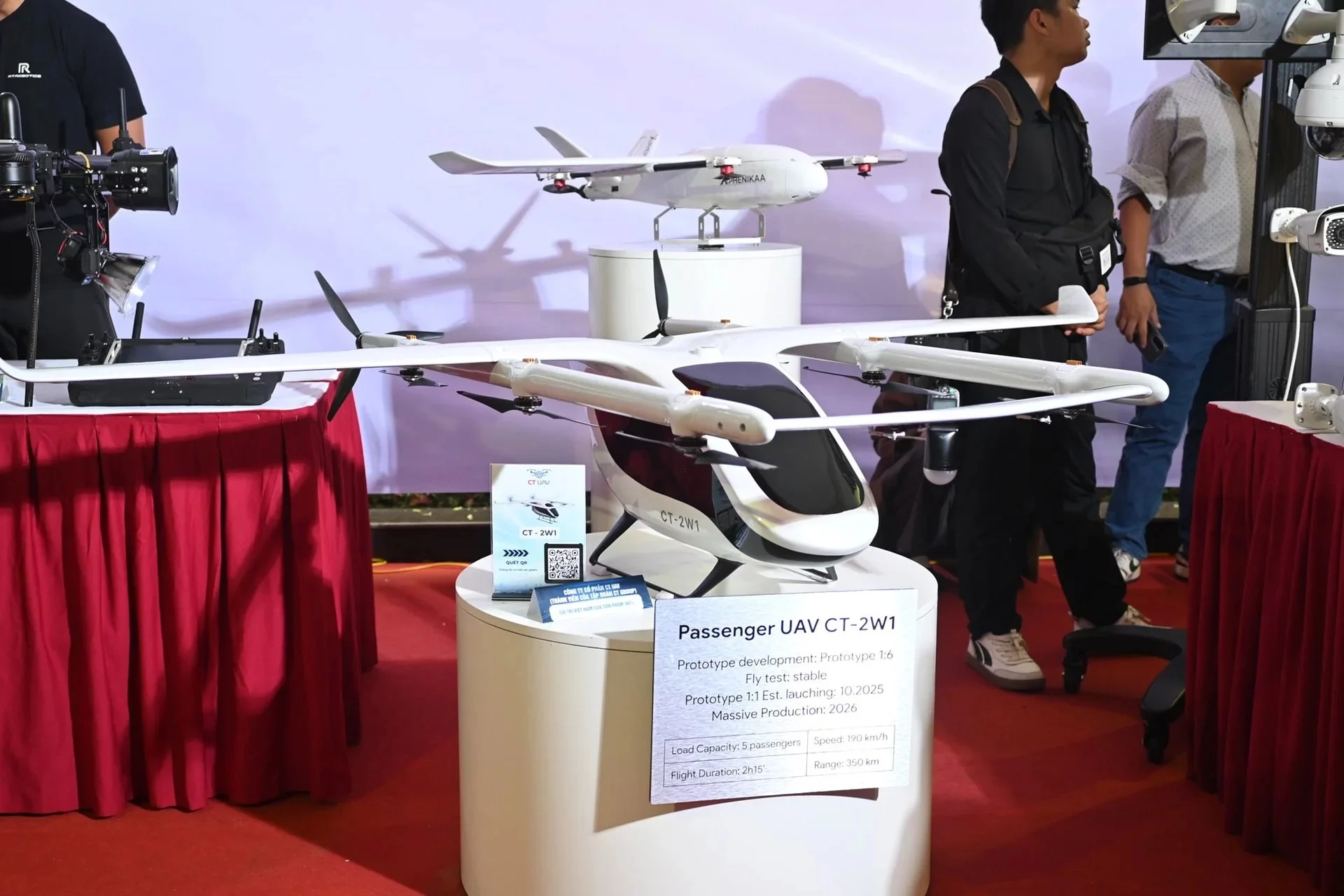
A UAV model developed by CT Group.
The MCU Module would be responsible for control functions and the execution of flight-safety algorithms, geofencing, mandatory identification requirements, and other regulatory control mechanisms. The secure Memory Module would contain a digitized database of applicable UAV regulations, no-fly zones, designated flight corridors, and regulatory parameters, with periodic updates as regulations change. It would also incorporate encryption and tamper-resistance mechanisms. The RF Module would transmit identification and remote compliance/certification signals while simultaneously sending real-time operational data to the National Data Center through secure network infrastructure.
According to CT Group, this approach would allow UAVs to operate broadly while remaining under strict regulatory oversight with respect to their operating airspace, flight routes, and data transmission. UAVs could therefore operate throughout permitted areas and within authorized altitude limits while automatically and proactively complying with applicable regulations, eliminating the need to obtain approval on a flight-by-flight basis.
Furthermore, in the event of a national-defense emergency, the Government could potentially use the chip-based system to coordinate UAVs nationwide and establish UAV defensive walls or multi-layered UAV defense domes for airspace defense, border protection, and the defense of Vietnam’s maritime and island territories.
CT Group proposed that the chipset be designed domestically, developed with locally controlled intellectual property, and packaged and tested in Vietnam. Beyond supporting Vietnam’s national UAV management framework, the technology could also be exported to international markets. According to the proposal, the costs of designing and manufacturing the chipset could be recovered through CT Group’s investment in a network of privately funded UAV inspection and certification centers, reducing the need for substantial state-funded investment.
In terms of the financial mechanism, CT Group proposed a private-investment model. Under this approach, the company would independently finance the research, design, and production of the proprietary chipset while seeking authorization to invest in and operate a network of UAV inspection and certification centers under a public-private partnership (PPP) model. Revenue generated from UAV inspections, certification services, and regulatory data services would provide the basis for recovering the costs associated with the design and manufacture of the chipset.
________________________